

Eval Labs preserves prompt context, run source, Lucia response, layered human judgment, lifecycle state, reviewer identity, and—when captured—Lucia runtime/model provenance. This page defines the public product contract, not the private database layout.
Evidence topology
Eval Labs has several durable evidence domains. Keep them separate:- General evaluation evidence — the run, ordered cases, Lucia responses, and Review Queue decisions.
- Behavioral evidence — intentionally saved Behavioral Observatory labels, distinct from review suggestions.
- Runtime verification evidence — immutable owner-only observations about a deployed runtime and model path.
- Fieldwork evaluation evidence — specialized claims, attempts, seals, protocols, execution receipts, cohorts, and recovery lineage.
Source, deployment, and live truth
The source and deployed build were reviewed on 2026-08-12. That review established the intended data flow and public export behavior, but it did not authenticate as every role, recount production records, or perform a new durable write. Use these claims separately:- Source contract — the tracked application and schema define the behavior.
- Deployment identity — a specific build is live.
- Live durable evidence — an authorized operation succeeded and the same record read back.
Authorization boundary
The application uses authenticated role and ownership context for durable operations:- owner and admin roles can oversee shared evaluation evidence where their privileged scope allows it;
- the runtime verification surface remains owner-only;
- evaluator and tester evidence remains scoped to their own allowed work except where owner/admin oversight applies; and
- an enabled control or visible route does not prove that the durable service will authorize a read or write.
Run and session contract
A run export preserves enough information to identify and interpret the evaluation:- stable run identity and title;
- launch source and test mode;
- category, subcategory, and suite or template context when applicable;
- prompt count, ordered case identity, lifecycle status, and timestamps;
- owning user and applicable ownership-scope version;
- failure classification and reason when the run did not complete; and
- captured runtime provenance when the evaluated response supplied it.
Ordered case contract
Each prompt becomes an ordered case. The export preserves:- stable case and parent-run identity;
- deterministic order within the run;
- source and classification context;
- prompt text and lock state;
- Lucia response, run outcome, and any typed error;
- timestamps; and
- captured runtime provenance when available.
Review contract
Prompt-level review evidence keeps these meanings distinct:- the current draft;
- the last intentionally saved review;
- when and by whom it was saved;
- app-suggested values;
- guided Employee Review signal;
- Human Guidance Evaluation;
- senior adjudication and canon-candidate state; and
- dirty, completion, and run-finalization state.
Runtime and model provenance
For newly executed runs, Eval Labs can preserve runtime evidence returned with Lucia’s answer. The public provenance contract includes:- target endpoint and environment classification;
- Engine service, build, and version identity;
- request identity and verification time;
- configured and provider-resolved model identity;
- whether a model was invoked or the response followed a deterministic path;
- whether fallback behavior occurred; and
- task-level attempt, response, parsing, and model-resolution outcomes.
Confirmed routing drift
Configuration and deployment evidence establishes that the confirmed uninterrupted production-routing drift toward Staging began on 2026-05-04. Routing was corrected to Development and live-verified on 2026-07-10. That interval is routing history, not proof that every run in the interval used Staging. Only evidence captured with an individual run can establish its runtime.Exporter and reviewer identity
The exporter is the person who produced the file. The saved-by reviewer is the person who intentionally saved a prompt review. One person may export a run reviewed by another, so the two identities must not be collapsed. Exports retain only the limited identity needed for authorship and audit: the product user identifier, email, and display name. Role metadata governs access; it is not review authorship.Expected empty values
Empty values are normal when the corresponding event has not happened. Examples include:- no failure classification on a successful run;
- no saved reviewer on an unreviewed prompt;
- no ratings before scoring; and
- no runtime provenance on a historical run that predates capture.
Export formats
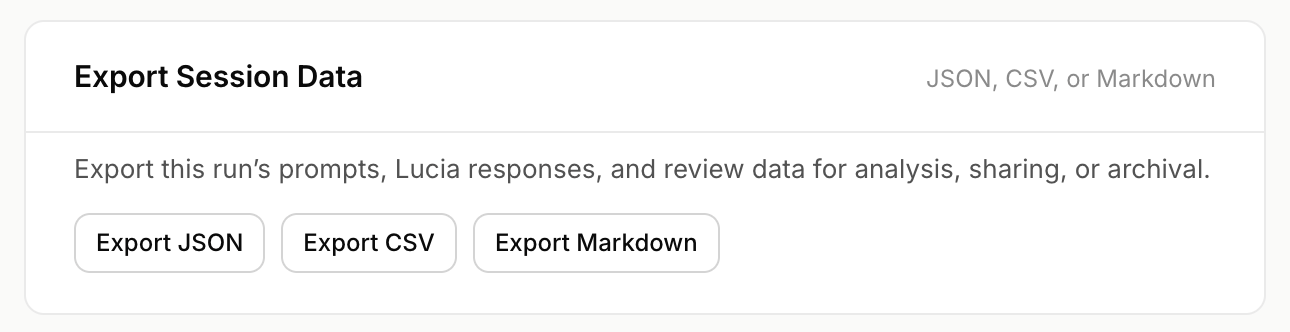
- JSON preserves the richest nested run, case, review, lifecycle, identity, and captured-provenance contract.
- CSV supports tabular analysis while flattening nested evidence.
- Markdown supports human-readable review packets and summaries.
Durable persistence contract
The durable service preserves run lifecycle, ordered case context, prompt-level review evidence, and authorship. Behavioral Observatory labels remain a separate evidence domain, with one saved label per reviewer per run item. For any durable evidence claim, all of these must hold:- the authenticated operation is authorized for the intended evidence domain;
- the service confirms the write;
- the UI reports success only after that confirmation;
- the same evidence hydrates after refresh; and
- failed or ambiguous writes remain non-committable and are not counted.