> ## Documentation Index
> Fetch the complete documentation index at: https://helloluciallc.com/llms.txt
> Use this file to discover all available pages before exploring further.
# Data Model and Export Contract
Eval Labs data is designed to preserve prompt context, run source, Lucia response, layered review judgment, lifecycle state, tester identity, and—on newly executed runs—captured Lucia runtime/model provenance.
***
## Session metadata
A session export includes metadata such as:
```text theme={"dark"}
id
title
mode
runSource
category
subcategory
templateKey
promptCount
status
createdAt
updatedAt
adminBranch
engineBranch
runFailureType
runFailureReason
runFailureAt
reviewLifecycle
remoteRunId
ownerUserId
ownerScopeVersion
localPayloadState
runtimeProvenance
```
The important field for the custom launcher is:
```text theme={"dark"}
runSource: custom
```
Custom and Auto-generated launchers both create run sessions that flow into the same Review Queue. The session `mode` remains the run mechanics; `runSource` distinguishes whether the run came from the Custom launcher or the Auto-generated launcher.
Controlled batch readiness runs also rely on the same run/session lifecycle, but their product meaning is different: they are platform readiness evidence, not normal evaluator-facing tests.
Registry Diagnostics reads existing session/run/review evidence and derives dataset membership and review-lane suggestions from it. Those suggestions are diagnostic output, not saved labels.
Behavioral Observatory labels are separate persisted records when saved through the Behavioral Observatory flow.
***
## Cases
Each prompt becomes a case.
A case contains:
```text theme={"dark"}
id
sessionId
orderIndex
sourceType
title
promptText
promptLocked
luciaResponse
runStatus
runError
category
subcategory
templateKey
runtimeProvenance
createdAt
updatedAt
```
Order matters. The exported `orderIndex` must remain stable.
***
## Prompt results
Prompt results include:
* draft review state, including reviewer input and suggestions
* saved review state
* saved timestamp
* saved-by tester identity
* completion/dirty state derived from saved vs draft review
A generated-but-unreviewed item may have null ratings and `savedBy: null`.
That is expected.
A saved review should include `savedBy`.
***
## Runtime and model provenance
Eval Labs production targets Lucia Engine Development at:
```text theme={"dark"}
https://api-dev.hellolucia.ai/admin/operator-focus
```
The Engine returns runtime evidence in the same `/admin/operator-focus` response as the evaluated answer. Eval Labs captures that evidence as `runtimeProvenance` for new runs, persists it on the case, and mirrors the latest captured value in the session metadata. The JSON session export contains both records, so the full captured evidence travels with JSON exports. Current CSV and Markdown exports do not include the full provenance object.
The current stored object uses these exact fields:
```text theme={"dark"}
runtimeProvenance: {
target_endpoint
target_environment
engine_service_id
engine_environment
engine_commit_sha
engine_version
request_id
configured_model
resolved_model
model_invoked
deterministic_path
fallback_used
model_tasks
runtime_verified_at
}
```
Each `model_tasks` item may contain:
```text theme={"dark"}
task
model_call_attempted
model_response_received
parsing_succeeded
requested_model
resolved_model
fallback_used
status
```
These are persisted schema keys, not merely suggested export labels. The owner-only Lucia Runtime Verification dashboard presents the corresponding resolved endpoint, classified and Engine environments, Engine commit SHA, configured model, provider-resolved model, model-invoked state, deterministic-path state, fallback state, model-task evidence, and verification timestamp.
`configured_model` records the Engine configuration. `resolved_model` records the provider-resolved model captured from the Engine response. A configured model alone does not prove that a model ran. `model_invoked` and `deterministic_path` are complements: they record whether any model task was attempted. `fallback_used` is independent and may be true with either state. Task evidence separately proves whether a provider response arrived, parsing succeeded, and a resolved model was captured.
Live verification on 2026-07-10 produced this evidence:
```text theme={"dark"}
status: Verified
configured_model: gpt-5.6-sol
resolved_model: gpt-5.6-sol
model_invoked: true
deterministic_path: false
fallback_used: false
```
Historical records are not backfilled. When a run predates provenance capture or otherwise has no stored `runtimeProvenance`, Eval Labs states: “Runtime provenance was not captured for this run.” Do not infer an endpoint, environment, Engine commit, model, or invocation path for that run.
### Confirmed routing drift
Configuration and deployment evidence establishes that the confirmed uninterrupted Eval Labs production routing drift toward Staging began at `2026-05-04T16:21:35Z`. Routing was corrected to Development and live-verified on 2026-07-10.
That interval is a routing-history fact, not proof that every individual historical run used Staging. Only per-run captured provenance can establish the runtime used by a specific run. Runs without it remain explicitly unverified rather than being rewritten.
***
## `exportedBy` vs `savedBy`
`exportedBy` identifies who exported the file.
`savedBy` identifies who reviewed/saved the individual prompt.
This distinction matters because one person may export a run that another person reviewed.
***
## Tester identity fields
Eval Labs stores only limited identity fields:
```text theme={"dark"}
clerkUserId
email
name
```
No unnecessary Clerk metadata should be stored.
Role gating reads Clerk public metadata through `eval_labs_role`, but role metadata is product access state, not review authorship.
***
## Nulls in exports
Some nulls are normal.
Expected nulls include:
```text theme={"dark"}
runFailureType: null
runFailureReason: null
runFailureAt: null
savedBy: null when not reviewed yet
ratings: null when not scored yet
```
Do not treat every null as a bug.
Treat nulls as suspicious only when the workflow step should have populated them.
***
## Export Options and Example
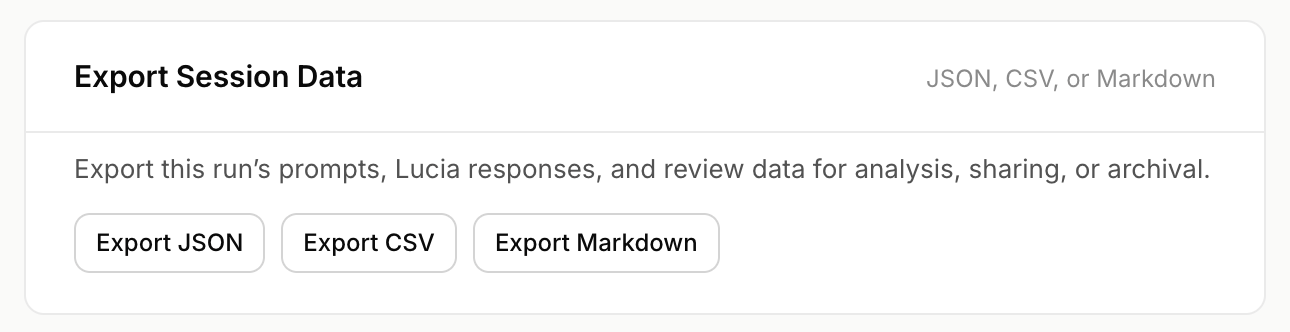 *Export controls for easy usability with multiple data formats.*
The compact example below focuses on the core session/review shape. Current JSON session exports carry `runtimeProvenance` at session and case level when it was captured; the exact current keys are defined above. Current CSV and Markdown exports omit the full object, and historical JSON exports may omit it.
```json theme={"dark"}
{
"format": "lucia-eval-lab-session/v0.3",
"exportedAt": "2026-04-29T19:33:10.000Z",
"exportedBy": {
"clerkUserId": "user_3D2BItLYUO1uqJOqzlZTvHZNgsF",
"email": "aviv@hellolucia.ai",
"name": "Aviv Hadar"
},
"session": {
"metadata": {
"id": "session-example",
"runSource": "custom",
"status": "ready",
"reviewLifecycle": {
"status": "in_review",
"finalizedAt": null,
"finalizedBy": null
}
},
"caseOrder": ["case-001"],
"cases": {
"case-001": {
"orderIndex": 0,
"promptText": "I'm spinning a little. Tell me what to do first so I can breathe again.",
"luciaResponse": "Take a breath. This feels heavier than it is. Nothing critical is slipping beyond the first move.",
"runStatus": "success"
}
},
"promptResults": {
"case-001": {
"draft": {},
"saved": null,
"savedAt": null,
"savedBy": null
}
}
}
}
```
***
## Review-layer fields
Prompt reviews now support these additional fields:
```text theme={"dark"}
ratings
suggestedRatings
keepTalking
suggestedKeepTalking
status
suggestedStatus
priority
suggestedPriority
reviewState
luciaPredictedLabels
humanLabels
adjudication
employeeReview
suggestedEmployeeReview
humanGuidanceEval
suggestedHumanGuidanceEval
canonCandidate
```
The suggested fields are product suggestions, not final reviewer judgment. They are generated from prompt/response/run-status heuristics and remain separate from the reviewer-saved values.
Suggested fields may feed derived context in Registry Diagnostics or Behavioral Observatory, but they do not become persisted Behavioral Observatory labels unless a reviewer saves a label in the Behavioral Observatory surface.
***
## Employee Review object
Employee Review captures guided non-expert signal:
```text theme={"dark"}
understoodNeed
rightNextMove
calmingEffect
riskOrConfusion
seniorReview
reusableLearning
```
These fields are intentionally simple and should remain employee-friendly.
***
## Human Guidance Evaluation object
Human Guidance Evaluation captures a 1-5 review layer:
```text theme={"dark"}
emotionalValidation
cognitiveUnderstanding
actionability
toneAppropriateness
authenticity
notes
```
Warmth and intelligence are not separate export fields. They are expressed through the current scoring dimensions and guidance fields: `tone`, `calming`, `naturalness`, `trust`, `usefulness`, `cognitiveUnderstanding`, `actionability`, and `authenticity`.
***
## Adjudication object
Adjudication captures final senior-review meaning when it exists in the review record:
```text theme={"dark"}
finalLabels
reason
adjudicator
adjudicatedAt
```
Final labels may include:
```text theme={"dark"}
guestIntent
followThroughRequired
actionType
emotionalRead
ownerStressLevel
```
***
## Review lifecycle object
Run lifecycle finalization is stored at the session level:
```text theme={"dark"}
status: in_review | ready_to_finalize | finalized
finalizedAt
finalizedBy
```
Finalization does not replace per-prompt review data. It marks the run lifecycle after all prompts are reviewed.
***
## Supabase persistence contract
The Supabase persistence layer stores the run and item contract in three places:
```text theme={"dark"}
eval_runs.metadata.reviewLifecycle
eval_runs.metadata.metadata
eval_run_items.payload.case
eval_run_items.payload.promptRecord
eval_item_reviews
```
`eval_run_items.payload.promptRecord` embeds the full prompt review record, including saved/draft state, suggested review, employee review, Human Guidance Evaluation, adjudication metadata, canon candidate signal, tester identity, and dirty/completion state.
`eval_item_reviews` is still written for review rows, but hydration prefers the embedded `eval_run_items.payload.promptRecord` instead of relying on fragile review-table reads.
Behavioral Observatory labels are stored separately:
```text theme={"dark"}
public.eval_behavioral_labels
```
This table stores first-class Behavioral Observatory labels:
```text theme={"dark"}
run_id
run_item_id
owner_user_id
reviewer_user_id
intent
guest_affect
response_strategy
humanness
notes
status
payload
created_at
updated_at
```
The key distinction:
```text theme={"dark"}
eval_item_reviews = Review Queue review evidence
eval_behavioral_labels = Behavioral Observatory label evidence
```
One saved Behavioral Observatory label exists per reviewer per run item.
Current persisted run evidence is scoped by the signed-in Clerk user and the role claim available to Supabase RLS. Owner/admin can inspect shared persisted evidence where privileged RLS allows it. Evaluator and tester data remains scoped to their own work except where owner/admin oversight applies.
Current readiness verification checks counts across:
```text theme={"dark"}
public.eval_runs
public.eval_run_items
public.eval_item_reviews
```
For the 60-run readiness gate, the final verified result was:
```text theme={"dark"}
ready | 60 | 3000 | 3000 | 3000 | 3000
```
Meaning:
* 60 ready runs
* 3,000 expected prompts
* 3,000 run items
* 3,000 non-empty Lucia responses
* 3,000 reviews for the tested reviewer id
***
## localStorage compaction contract
Completed cloud-backed runs should not leave full item-level payloads persisted in localStorage.
The platform-readiness diagnostic target is:
```text theme={"dark"}
persistedLocalFullPayloadSessionCount = 0
persistedLocalHasItemLevelData = false
persistedLocalItemLevelDataSessionCount = 0
ownedSessionCount = expected run count
otherOwnerSessionCount = 0
ownerlessSessionCount = 0
```
The final verified 60-run diagnostic was:
```text theme={"dark"}
sessionCount = 60
persistedLocalFullPayloadSessionCount = 0
persistedLocalHasItemLevelData = false
persistedLocalItemLevelDataSessionCount = 0
ownedSessionCount = 60
otherOwnerSessionCount = 0
ownerlessSessionCount = 0
rawByteSize ≈ 68,815
```
This supports platform readiness and client compactness. It does not prove backend authorization is complete.
***
## Export rule
Exports should preserve the full review contract:
```text theme={"dark"}
employeeReview = what the reviewer experienced
suggestedEmployeeReview = what the app suggested
humanGuidanceEval = structured 1-5 human guidance
suggestedHumanGuidanceEval = app-suggested human guidance
adjudication = final senior-review metadata when present
reviewLifecycle = whether the run is still in review or finalized
```
Do not collapse these into one field.
*Export controls for easy usability with multiple data formats.*
The compact example below focuses on the core session/review shape. Current JSON session exports carry `runtimeProvenance` at session and case level when it was captured; the exact current keys are defined above. Current CSV and Markdown exports omit the full object, and historical JSON exports may omit it.
```json theme={"dark"}
{
"format": "lucia-eval-lab-session/v0.3",
"exportedAt": "2026-04-29T19:33:10.000Z",
"exportedBy": {
"clerkUserId": "user_3D2BItLYUO1uqJOqzlZTvHZNgsF",
"email": "aviv@hellolucia.ai",
"name": "Aviv Hadar"
},
"session": {
"metadata": {
"id": "session-example",
"runSource": "custom",
"status": "ready",
"reviewLifecycle": {
"status": "in_review",
"finalizedAt": null,
"finalizedBy": null
}
},
"caseOrder": ["case-001"],
"cases": {
"case-001": {
"orderIndex": 0,
"promptText": "I'm spinning a little. Tell me what to do first so I can breathe again.",
"luciaResponse": "Take a breath. This feels heavier than it is. Nothing critical is slipping beyond the first move.",
"runStatus": "success"
}
},
"promptResults": {
"case-001": {
"draft": {},
"saved": null,
"savedAt": null,
"savedBy": null
}
}
}
}
```
***
## Review-layer fields
Prompt reviews now support these additional fields:
```text theme={"dark"}
ratings
suggestedRatings
keepTalking
suggestedKeepTalking
status
suggestedStatus
priority
suggestedPriority
reviewState
luciaPredictedLabels
humanLabels
adjudication
employeeReview
suggestedEmployeeReview
humanGuidanceEval
suggestedHumanGuidanceEval
canonCandidate
```
The suggested fields are product suggestions, not final reviewer judgment. They are generated from prompt/response/run-status heuristics and remain separate from the reviewer-saved values.
Suggested fields may feed derived context in Registry Diagnostics or Behavioral Observatory, but they do not become persisted Behavioral Observatory labels unless a reviewer saves a label in the Behavioral Observatory surface.
***
## Employee Review object
Employee Review captures guided non-expert signal:
```text theme={"dark"}
understoodNeed
rightNextMove
calmingEffect
riskOrConfusion
seniorReview
reusableLearning
```
These fields are intentionally simple and should remain employee-friendly.
***
## Human Guidance Evaluation object
Human Guidance Evaluation captures a 1-5 review layer:
```text theme={"dark"}
emotionalValidation
cognitiveUnderstanding
actionability
toneAppropriateness
authenticity
notes
```
Warmth and intelligence are not separate export fields. They are expressed through the current scoring dimensions and guidance fields: `tone`, `calming`, `naturalness`, `trust`, `usefulness`, `cognitiveUnderstanding`, `actionability`, and `authenticity`.
***
## Adjudication object
Adjudication captures final senior-review meaning when it exists in the review record:
```text theme={"dark"}
finalLabels
reason
adjudicator
adjudicatedAt
```
Final labels may include:
```text theme={"dark"}
guestIntent
followThroughRequired
actionType
emotionalRead
ownerStressLevel
```
***
## Review lifecycle object
Run lifecycle finalization is stored at the session level:
```text theme={"dark"}
status: in_review | ready_to_finalize | finalized
finalizedAt
finalizedBy
```
Finalization does not replace per-prompt review data. It marks the run lifecycle after all prompts are reviewed.
***
## Supabase persistence contract
The Supabase persistence layer stores the run and item contract in three places:
```text theme={"dark"}
eval_runs.metadata.reviewLifecycle
eval_runs.metadata.metadata
eval_run_items.payload.case
eval_run_items.payload.promptRecord
eval_item_reviews
```
`eval_run_items.payload.promptRecord` embeds the full prompt review record, including saved/draft state, suggested review, employee review, Human Guidance Evaluation, adjudication metadata, canon candidate signal, tester identity, and dirty/completion state.
`eval_item_reviews` is still written for review rows, but hydration prefers the embedded `eval_run_items.payload.promptRecord` instead of relying on fragile review-table reads.
Behavioral Observatory labels are stored separately:
```text theme={"dark"}
public.eval_behavioral_labels
```
This table stores first-class Behavioral Observatory labels:
```text theme={"dark"}
run_id
run_item_id
owner_user_id
reviewer_user_id
intent
guest_affect
response_strategy
humanness
notes
status
payload
created_at
updated_at
```
The key distinction:
```text theme={"dark"}
eval_item_reviews = Review Queue review evidence
eval_behavioral_labels = Behavioral Observatory label evidence
```
One saved Behavioral Observatory label exists per reviewer per run item.
Current persisted run evidence is scoped by the signed-in Clerk user and the role claim available to Supabase RLS. Owner/admin can inspect shared persisted evidence where privileged RLS allows it. Evaluator and tester data remains scoped to their own work except where owner/admin oversight applies.
Current readiness verification checks counts across:
```text theme={"dark"}
public.eval_runs
public.eval_run_items
public.eval_item_reviews
```
For the 60-run readiness gate, the final verified result was:
```text theme={"dark"}
ready | 60 | 3000 | 3000 | 3000 | 3000
```
Meaning:
* 60 ready runs
* 3,000 expected prompts
* 3,000 run items
* 3,000 non-empty Lucia responses
* 3,000 reviews for the tested reviewer id
***
## localStorage compaction contract
Completed cloud-backed runs should not leave full item-level payloads persisted in localStorage.
The platform-readiness diagnostic target is:
```text theme={"dark"}
persistedLocalFullPayloadSessionCount = 0
persistedLocalHasItemLevelData = false
persistedLocalItemLevelDataSessionCount = 0
ownedSessionCount = expected run count
otherOwnerSessionCount = 0
ownerlessSessionCount = 0
```
The final verified 60-run diagnostic was:
```text theme={"dark"}
sessionCount = 60
persistedLocalFullPayloadSessionCount = 0
persistedLocalHasItemLevelData = false
persistedLocalItemLevelDataSessionCount = 0
ownedSessionCount = 60
otherOwnerSessionCount = 0
ownerlessSessionCount = 0
rawByteSize ≈ 68,815
```
This supports platform readiness and client compactness. It does not prove backend authorization is complete.
***
## Export rule
Exports should preserve the full review contract:
```text theme={"dark"}
employeeReview = what the reviewer experienced
suggestedEmployeeReview = what the app suggested
humanGuidanceEval = structured 1-5 human guidance
suggestedHumanGuidanceEval = app-suggested human guidance
adjudication = final senior-review metadata when present
reviewLifecycle = whether the run is still in review or finalized
```
Do not collapse these into one field.